


Ductwork bends and tees are among the most critical components in any ventilation system. These ducting fittings allow you to route air where it needs to go, turning corners with elbows or splitting flow with branch pieces. Choosing the right bend or tee (and installing it correctly) can make the difference between a quiet, efficient system and one that struggles with poor airflow.
Here’s a straightforward overview of the duct bends and tees every installer should know – from the different types (90°, 45°, long-radius, Y-pieces, reducers, etc.) to their impact on airflow and compliance with UK standards. Whether you’re a seasoned HVAC contractor or planning a DIY install, this guide will help you plan air duct fittings that keep your system running smoothly.
At Fresh Air Supplies, we’ve spent over 35 years on both sides of the trade (installation and supply), so we know how important quality fittings are. In fact, poorly chosen or incorrectly installed fittings often lead to unnecessary pressure drops, increased energy use, and even failed building inspections. That’s why it’s vital to understand these components and choose the right duct fittings from the start.
Let’s break down the essentials.

Understanding Duct Bends (Elbows)
Duct bends (also known as elbows) are fittings that change the direction of airflow. They come in various angles and curvatures, each suited to different situations. The primary purpose of a bend is to navigate building obstacles (like walls or beams) while directing air with minimal resistance.
Here are the common types of duct bends and their characteristics:
90° Elbows (Right-Angle Bends)
A 90° bend is a sharp turn, commonly used when ductwork needs a right-angle change in direction (e.g. turning from horizontal to vertical). Standard 90° elbows have a relatively tight radius, which makes them compact but can create more turbulence as air negotiates the sharp turn.
In residential and light commercial systems, 90° elbows are very common for routing ducts along ceilings and walls. However, because the airflow must make a hard turn, these elbows do introduce a pressure drop (resistance). In fact, one rule of thumb is that a single 90° bend can impose a pressure loss equivalent to adding 10–15 duct diameters worth of straight duct to the system. In other words, sharp elbows effectively make the duct “feel” longer to the air, so it’s best not to use them more than necessary.
45° Elbows (Gentle Turns)
A 45° bend turns air at a more gradual angle. Sometimes called “45s” or “half bends,” these are used when you want to redirect airflow with less abruptness. Two 45° elbows can be used in sequence to simulate a smoother 90° turn, which often results in lower resistance than a single sharp 90°.
For example, an installer might opt for two 45° bends with a short straight section between them to create an effective sweeping turn that is easier on airflow. All else equal, a 45° elbow causes roughly half the pressure loss of a 90° elbow. The gentler angle means less turbulence and usually quieter operation, which is why 45s are favored when space and design permit.
Long-Radius or “Swept” Bends
Not all 90° elbows are equal – some have a long radius (also known as swept bends) which means the bend curves more gradually over a larger arc. The benefit of long-radius bends is significantly reduced airflow resistance. This means the long-radius bend causes only about 1/5 the pressure drop of the sharp elbow. Swept bends also generate less turbulence and noise. The downside is they require more space to install due to the larger bend radius.
In tight quarters, you may not physically have room for a long sweep, which is why standard elbows are still often used. Whenever you do have the space, however, using a long-radius bend (or a pair of 45° elbows to approximate one) is a best practice for airflow efficiency.

Duct Tees, Y-Pieces, and Branch Fittings
While bends change direction in one continuous duct run, tees and related fittings split or join duct runs. A “tee” in ductwork typically refers to a T-shaped junction where one duct connects into the side of another, forming a 90° branch.
However, there are a few different ways to create branch connections, each with pros and cons:
Straight T-Piece (90° Tee)
This fitting looks like a “T” – one end is the straight main run, and a branch of the same diameter tees off at 90°. Tees are common in extract systems and branch lines in supply systems. For example, a ventilation system might run a main trunk down a corridor and use T-pieces to tap off to individual rooms. The advantage of a standard tee is its simplicity and compact size.
Our Duct T Piece is an equal-size tee available from 100mm up to 630mm diameter, with male ends that slip into spiral pipe for easy connection. Because of its shape, a T-piece can fit into tighter spaces than a Y-piece – the branch comes off at a right angle, requiring less longitudinal space. In fact, using a T may allow a larger diameter branch in a confined spot where an angled Y-branch wouldn’t fit. The trade-off, however, is airflow dynamics. Air hitting a 90° tee tends to create more turbulence and a higher pressure loss compared to a gently angled split. Imagine water hitting a T junction – much of it slams into the opposing wall of the fitting.
In air terms, a tee causes a “shock loss” as the airflow changes direction abruptly. The branch airflow from a tee may also be lower than the straight-through airflow, which can complicate balancing (often the branch off a hard tee needs a damper to regulate flow split). Despite these drawbacks, standard tees are often perfectly fine for many extract systems (like bathroom or kitchen extracts) and are very useful when space is limited or when an abrupt take-off is acceptable.
Y-Piece (Wye Branch, Angled Tee)
A duct Y-piece is a branch fitting where the take-off is angled, typically 45° from the main run (forming a Y shape). This design splits airflow more smoothly. Instead of a sudden 90° collision, the air is guided into the branch at a gentler angle, resulting in lower resistance and often a more even split of flow. Y-pieces (sometimes just called “45° tees”) are highly recommended for supply air distribution, where you want to maintain as much pressure and flow as possible to all branches.
For instance, in an HVAC supply trunk, using Y-junctions will help deliver air to each branch with less pressure drop than a series of hard 90° tees. Generally speaking, a wye fitting yields less static resistance than a tee and can reduce noise and turbulence. The downside is that Y fittings require more linear space – the junction is stretched out diagonally. If you have room for it, a Y is almost always preferable for performance.
Reducers and Reducing Tees
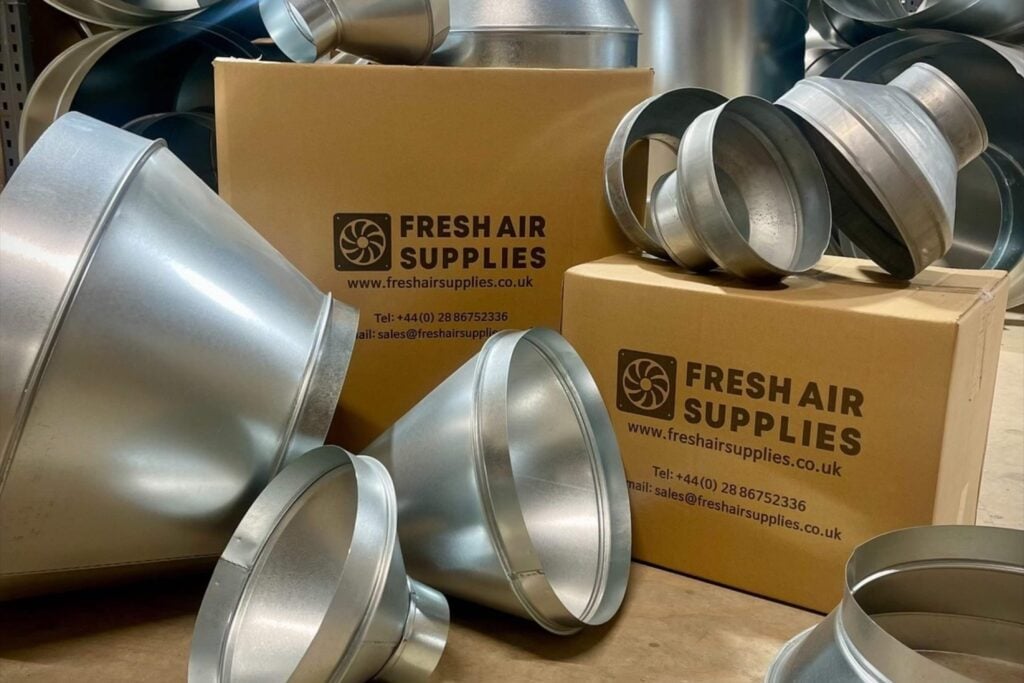
A reducer is a fitting that connects two different duct diameters – for example, going from a 250mm main down to a 200mm branch. In branch connections, you might have an “unequal tee” (one where the branch is smaller than the main) or you can achieve the same by coupling a separate reducer to a fitting. It’s usually best to use a tapered (conical) reducer rather than an abrupt step, as tapered reducers introduce minimal turbulence (a well-designed reducer can have essentially zero added pressure loss).
Fresh Air Supplies carries concentric duct reducers (galvanized steel) which gradually transition between diameters – these maintain smoother airflow. When branching off, if the main duct continues and you’re just tapping a smaller branch, a common approach is a saddle or boot (described next). But if the main ends in a split, you might use a Y reducer (one inlet, two outlets of smaller size). Always ensure the transition is smooth; abrupt jumps in size can cause separation of airflow and extra loss.
Saddle Take-Offs and Boots
A duct saddle is a curved outlet that can be cut into the side of a larger duct. Instead of inserting a full tee fitting, the installer cuts a hole in the main duct and attaches the saddle, which serves as the branch connection point. Often the saddle has a curved “boot” that leads into the branch duct at 90° or 45°. This approach can be very handy for large trunk ducts where you want to minimize disruption to the main flow. A well-designed saddle with a scoop or angled entry can extract some air into the branch with less turbulence than a blunt tee. It also avoids adding a lot of bulk – only a small protrusion on the main duct.
We stock duct saddles and curved take-off boots which can be strapped or riveted to round ductwork. These are especially useful in retrofit scenarios or when adding a branch after the main duct is already installed. While saddles are great for convenience, they must be sealed well to avoid leaks around the cut hole.
Also, the opening cut into the duct should ideally be smooth (often a rubber gasket or flange is used) to prevent edge turbulence. In terms of performance, a 45° angled boot on a saddle is effectively similar to a wye branch – gentle introduction – whereas a 90° saddle (sometimes just a round take-off) acts more like a tee.
Compliance with Building Regulations (Part F) and DW/144 Standards
In the UK, ventilation work isn’t just about performance – it also has to meet Building Regulations and industry standards. Two key references mentioned often are Approved Document F (Ventilation) of the building regs, and DW/144 (the industry specification for sheet metal ductwork).
Let’s briefly explain what these mean for duct bends and tees:
Building Regulations Part F
This is the legal guidance that ensures buildings have adequate ventilation for health and safety. Part F covers both natural and mechanical ventilation requirements. For mechanical systems (fans and ducts), Part F emphasizes designing the system to deliver the required airflow rates efficiently. A big part of that is duct design.
The latest Approved Document F (2021 update) explicitly advises that ductwork be designed to “minimise overall length of duct, [and] minimise the number of bends” and be appropriately sized for the airflow. This makes perfect sense – shorter, straighter ducts with fewer bends mean less resistance and quieter, more efficient ventilation.
So, when planning your runs, if you can eliminate an unnecessary bend or take a more direct route, do it. The document also puts specific limits on flexible duct use in dwellings: flexible ductwork should only be used for final connections and limited to 1.5 m length (for an axial fan system; slightly more for centrifugal fans in some cases). The reasoning is exactly what we discussed: too much flex or too many bends can throttle a system.
Following Part F guidance not only keeps you compliant with building control, but it generally leads to better performing systems.
DW/144 – Ductwork Specification
DW/144 is a long-standing standard (from BESA, formerly HVCA) that specifies how sheet metal ductwork should be made and installed. It covers materials, thicknesses, reinforcement, sealing, and so on for ducts and fittings. When we say a fitting is “to DW/144”, it means it meets the criteria set out in that standard.
For instance, DW/144 defines that a circular duct and fitting up to a certain diameter must have a rolled edge or flange and use a sealing method to achieve a particular air leakage class. It also dictates the gauges of steel for various duct sizes and pressure ratings. How does this relate to bends and tees? For one, a DW/144-compliant fitting will be of solid construction and sized accurately to fit standard ducts (e.g., a 200mm DW/144 bend will fit a 200mm spiral duct snugly). It also implies the fitting is designed for minimal leakage (often using sealant or gaskets at joints).
Moreover, DW/144 touches on design aspects: it notes the importance of balancing airflow and the appropriate use of bends, junctions, dampers, etc., to ensure the system performs well. Essentially, it’s promoting good practice – don’t throw in a bunch of ill-considered fittings; plan them. Adhering to DW/144 in your ductwork construction and layout helps ensure you meet not only performance goals but also things like fire safety, noise, and durability.
Many large projects in the UK will state “ductwork to be installed to DW/144”, meaning the contractor must follow that standard. At Fresh Air Supplies, all of our spiral ductwork and standard fittings are manufactured in accordance with DW/144. That includes our bends and tees, which are made from galvanized steel of the correct gauge and have features like rolled edges as required. By using DW/144-rated components, you’re essentially using parts that meet a baseline of quality and compatibility.

Installation Best Practices for Bends and Tees
Having the right parts is only half the battle – how you install duct bends and tees will determine if the system actually performs as intended. Here are some installer tips and best practices to ensure your duct fittings function optimally:
1.Plan the Layout to Minimise Fittings
Before you start cutting duct or punching holes, take the time to sketch out or mentally map the duct run. Can you reduce the number of turns? Is there a more direct route to that outlet? Every extra bend or tee you eliminate at the planning stage is one less potential point of failure. As Part F emphasizes, keep ducts short and straight where possible. For instance, instead of zig-zagging around obstacles with multiple 90s, see if moving the duct run slightly (or relocating a fan) could avoid that. A well-planned layout also helps you avoid awkward angles that end up needing “creative” install fixes later.
2. Use Smooth Transitions
When you do need bends, use the longest radius that fits. If you only have standard short-radius elbows, consider using two 45° elbows to make a smoother 90° turn (with a short piece of straight duct between them). For branch-offs, prefer 45° Y-connections over hard tees when space allows. If you must use a 90° tee due to space, perhaps oversize the branch duct to reduce its resistance or install a balancing damper. Also, if a branch comes off a main at an odd angle (not 90 or 45), look into adjustable elbows or segmented tees that can be fabricated to that angle – avoiding a tortuous flex duct loop to achieve the offset. Essentially, match the fitting to the situation rather than forcing a bad fit.
3. Support the Duct Near Fittings
Bends and tees add weight and also can create stress on duct joints (especially if air is pushing on them). Make sure you support ductwork on either side of a bend or tee. Hangers or brackets should be placed within a short distance of heavy fittings so that the joint isn’t bearing the load alone. For horizontal runs, a common rule is supports every 1.2–1.5 m, and certainly at least at each duct joint or fitting. Proper support prevents ducts from sagging or twisting, which in turn keeps your fittings aligned and leak-free. Nothing’s worse than a beautiful long-radius elbow that ends up skewed or ovalized because the duct is drooping – it can leak or reduce the cross-section. Use galvanized steel strapping, duct hangers, or support brackets as appropriate. On vertical ducts, ensure the tee branches are independently supported so they don’t slide down or pop off over time.
4. Seal Joints and Connections
Even the best-fitting elbow or tee will leak air if the joint isn’t sealed. For spiral duct systems, many fittings are “male” ends that slip into the duct (“female”) ends. These should be secured (with screws or rivets) and sealed. We recommend using proper duct sealant (mastic) or at least high-quality aluminum foil tape on all transverse joints. If you’re using our rubber gasketed fittings, the seal is built-in – still, ensure the gasket is evenly seated. For flexible duct connections, use worm-drive hose clamps (jubilee clips) or purpose-made flex duct couplers, not just duct tape. In fact, Part F notes to use rigid connectors and clamps for flex to ensure a good seal and mechanical hold. After installation, take a moment to run a hand over each joint; you’ll often feel if air is escaping once the system is on. Or use a smoke pencil around suspect joints to check for leaks. Airtight joints mean the air goes where it’s supposed to – out the grilles, not leaking into a void.
5. Avoid Hard Bends in Flex Duct
If you must use some flexible duct, treat it gently. Don’t yank it around a tight corner; you’ll just constrict it or tear the inner liner. Instead, make a sweeping curve. If the radius is too tight, consider transitioning to a hard elbow there. Often a short hard duct/elbow combo can be used in the middle of a flex run if needed – e.g., coming off the top of an MVHR unit with a sharp elbow, then attaching flex to that for sound dampening. Also, never leave flex in a heap – cut off extra length. Excess flex not only adds resistance, it also tends to loop or snag on things, and it looks unprofessional. Secure flex with straps so it doesn’t flop around.
Fresh Air Supplies Expertise – Your Source for Quality Ducting Fittings (UK)
As a leading supplier of ducting fittings UK wide, Fresh Air Supplies is here to support contractors, engineers, and DIY enthusiasts in getting the job done right. We don’t just sell ductwork; we manufacture many of our own components and provide the technical guidance to use them effectively. Here’s what you can expect from our range and service:
Comprehensive Product Range
We stock a full range of duct fittings – from the humble 45° and 90° duct bends (available in all common diameters) to equal and reducer tee pieces, Y-pieces, saddles, reducers, and more. Whether you need a simple air duct fitting or a custom-fabricated special, we likely have it or can make it. For instance, our 90 Degree Duct Bend and 45 Degree Duct Bend products are fabricated in galvanized steel and designed to DW/144 standards, ensuring a perfect fit with spiral duct and leak-free performance. Our Duct T Piece connectors are heavy-duty yet compact, ideal when you need to split extraction from multiple areas. We also carry all the accessories like duct reducers for different size transitions, couplers and flanges for joining, and flexible ducting (insulated and uninsulated) for those final connections.
In-House Manufacturing – Leak-Free Spiral Systems
Unlike many suppliers, we manufacture our own galvanized spiral ducting and many fittings right here in the UK. This means we control the quality from end-to-end. Our in-house made spiral duct and fittings feature rolled edges and can be supplied with factory-fitted seals or gaskets for high airtightness. We ensure every bend and tee fits true and doesn’t require wrestling on site – a snug fit that you can seal quickly.
Being the manufacturer also means if you have a special requirement (say an odd-angle elbow or an unusual size tee), we can often fabricate a bespoke piece to order. The benefit to you is a truly leak-free system – something we know our customers value highly. As we highlighted earlier, we take compliance seriously, so all standard items meet DW/144 specs for thickness and construction. When you buy from Fresh Air Supplies, you’re getting the same quality that we would install on our own projects (and as former contractors, we’re pretty picky).
Expert Advice and Support
Not sure which fitting you need or how to tackle a tricky run? Our team has decades of field experience. We’re happy to advise on best practices, help calculate what fittings and sizes you require, or give tips for installing a particularly challenging layout. We can assist with interpreting Building Regs requirements or DW/144 classes if your project spec calls for it. Essentially, consider us part of your project’s success team, we want to make sure you get the right product and use it correctly. We’ve built a reputation on being approachable and solution-oriented.
Fast UK-Wide Delivery and Stock Availability
We know construction timelines can be tight. That’s why we maintain huge stock levels of common ducting fittings so they’re ready to ship when you need them. Based in Mid Ulster, we deliver across the UK and Ireland quickly. Many of our products are available for next-day delivery or short lead times.
Additionally, we offer an out-of-hours collection service for local contractors who need to pick up items outside normal hours. When you choose Fresh Air Supplies, you’re choosing a supplier who understands the importance of timing – we strive to have what you need on the shelf, or fabricated in short order, to keep your project on track.
Ready to put together a truly efficient ductwork layout? Need advice on selecting the perfect bends and tees for your job? Feel free to reach out to our team at Fresh Air Supplies. We’re passionate about ventilation and always ready to help, whether it’s a quick product recommendation or a deep dive into a duct design. With our extensive stock, fast delivery, and knowledgeable support, we aim to be the go-to partner for ducting fittings in the UK.
Get in touch with us at 028 8675 2336 or via email at sales@freshairsupplies.co.uk and let’s ensure your next project has fresh, clean air moving through it with ease, from the straight ducts to every bend and branch along the way.