

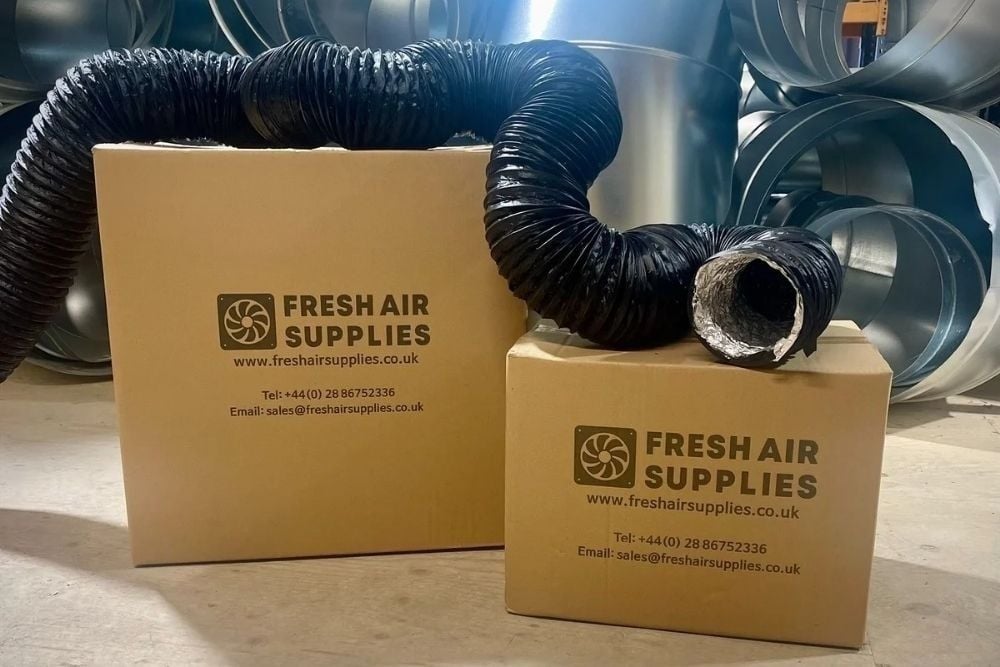
Flexible ductwork can look deceptively simple.
A roll of ducting arrives on site, gets cut to length, connected to a fan, and the job moves on.
In reality, choosing the wrong type can create all sorts of problems later. Condensation in lofts. Noise complaints in bedrooms. Reduced airflow. Systems that struggle once colder weather arrives.
That is exactly why different types of flexible ductwork exist in the first place.
At Fresh Air Supplies, we stock a wide range of flexible ducting solutions for domestic, commercial, and industrial ventilation projects across the UK and Ireland. Each product is designed for a different application, and understanding where each one belongs can make a major difference to long-term system performance, installation quality, and reliability on site.
Why the Type of Flexible Ductwork Matters
Flexible ductwork is not one single product category.
The construction varies significantly between products, including the inner lining, insulation layer, reinforcement, outer coating, acoustic properties, and temperature resistance. Those differences directly affect:
- Airflow resistance
- Noise transmission
- Thermal performance
- Durability
- Condensation control
- Ease of installation
Get the specification right and the ventilation system performs properly for years.
Get it wrong and the fan often ends up compensating for problems caused by the duct itself.
This is particularly important now that ventilation standards under Approved Document F place greater emphasis on airflow performance, continuous ventilation, and correct commissioning in modern airtight homes.
Standard PVC Flexible Ductwork
Standard PVC flexible ducting remains one of the most widely used options for general-purpose ventilation and air movement applications.
Manufactured from reinforced polyester fabric with a PVC coating, it is lightweight, flexible, airtight, and easy to manipulate on site.
Because it bends easily and can be cut quickly to length, installers often use it where speed and flexibility are important.
Typical applications include:
- Tumble dryer vent connections
- General extract ventilation
- Fresh air supply fans
- Short duct runs
- Temporary ventilation setups
- Low-pressure air movement systems
One of the biggest advantages of standard PVC flex is how easy it is to route through awkward ceiling voids, cupboards, service risers, and confined spaces where rigid ductwork would require multiple fittings.
For many basic domestic applications, it does the job perfectly well.
However, it is important to understand its limitations.
Standard PVC flexible ducting is generally better suited to lighter-duty applications than aluminium-based flexible ductwork. It does not offer the same temperature resistance, structural durability, or long-term performance in demanding extract systems such as kitchen ventilation.
Like all flexible ducting, it can also create significant airflow resistance if installed poorly.
We regularly see installations where flexible duct has been:
- Left compressed
- Bent sharply around obstructions
- Sagging between supports
- Installed in unnecessarily long runs
Every one of those issues restricts airflow and increases fan workload.
To get the best performance from standard PVC flexible ductwork, it should always be:
- Fully stretched during installation
- Kept as short as possible
- Properly supported throughout the run
- Installed with minimal bends
- Sealed correctly at all joints
Used correctly, it remains a cost-effective and practical solution for many everyday ventilation applications.
PVC Coated Aluminium Flexible Ductwork (COMBIFLEX)
PVC coated aluminium flexible ducting, commonly referred to as COMBIFLEX, is a heavier-duty flexible duct designed for more demanding ventilation systems.
It is manufactured from multiple layers of aluminium foil with a reinforced steel wire helix and protective PVC outer coating. This construction gives it greater durability, higher temperature resistance, and improved resistance to moisture, grease, chemicals, and UV exposure compared to standard PVC flex.
At Fresh Air Supplies, COMBIFLEX is one of the most popular choices for:
- Cooker hood extract
- Kitchen ventilation
- HVAC supply and extract systems
- Commercial ventilation
- Light industrial applications
Because the aluminium construction tolerates higher temperatures, it is much better suited to kitchen extract systems where warmer air and grease particles are present.
The PVC coating also provides additional protection and helps prevent condensation forming on the outer surface in many installations.
Another major advantage is durability.
On busy commercial projects or difficult installations where ducting may be exposed during construction phases, standard lightweight flex can easily become damaged. COMBIFLEX offers a far more robust solution.
That said, it is still important not to treat flexible ductwork as a substitute for proper rigid duct design over long distances.
Even high-quality flexible ducting creates more resistance than spiral ductwork because of the ribbed internal surface. Longer runs should still rely primarily on rigid ductwork, using flexible sections only where movement, alignment, or connection flexibility is genuinely required.
It is also worth noting that while COMBIFLEX is suitable for many kitchen extract applications, it is not intended to replace dedicated fire-rated commercial kitchen extract ductwork systems where specialist specifications apply.
Insulated Flexible Ductwork
Insulated flexible ductwork is built around a flexible inner duct with an additional layer of glass wool insulation and an external protective sleeve.
Its primary purpose is temperature control and condensation prevention.
Whenever warm extract air travels through a cold loft or unheated void, the air temperature can quickly drop below dew point. Once that happens, condensation forms inside the duct.
This is one of the most common causes of:
- Dripping ceiling valves
- Damp loft insulation
- Water staining
- Mould growth around terminals
- Reduced system performance
We see this regularly on poorly specified bathroom extract systems where standard flex has been installed through cold roof spaces without insulation.
Insulated flexible ductwork helps prevent that by maintaining the air temperature as it passes through colder parts of the building.
It is particularly important for:
- Bathroom extract systems
- MVHR duct runs crossing lofts
- Utility room extract
- Heat recovery systems
- Air conditioning systems
- Any installation carrying warm moist air through unheated areas
The insulation layer also provides some secondary acoustic benefit by reducing transmitted airflow noise.
While insulated ductwork costs slightly more upfront, it is almost always cheaper than trying to rectify condensation problems after installation.
From a compliance point of view, properly insulated extract ductwork also supports Approved Document F requirements by helping ventilation systems maintain designed airflow performance year-round.
Acoustic Flexible Ductwork
Acoustic flexible ductwork is specifically designed to reduce noise travelling through the ventilation system.
Inside the duct, the inner liner is typically perforated, allowing sound energy to pass into surrounding acoustic insulation where it becomes absorbed before continuing further along the duct run.
In practical terms, acoustic ducting helps reduce:
- Fan noise
- Air turbulence noise
- Cross-talk between rooms
- Noise transfer through MVHR systems
This makes it especially useful in:
- Bedrooms
- Apartments
- Offices
- Treatment rooms
- Meeting rooms
- Residential MVHR systems
It can also help where there is limited space for traditional rigid attenuators.
However, acoustic ducting should never be viewed as a quick fix for poor system design.
A large percentage of ventilation noise complaints actually come from:
- Undersized ductwork
- Excessive air velocity
- Poor fan selection
- Too many bends
- Incorrect commissioning
- Poor terminal selection
Acoustic flexible ductwork works best when used as part of a properly designed low-resistance system rather than as a way of masking design problems.
In most high-performing systems, noise reduction starts with correct duct sizing and sensible airflow design long before acoustic ductwork is added.
Matching the Product to the Installation
The best flexible ductwork always depends on the application.
There is no single product that suits every project.
As a general rule:
Standard PVC Flex
Best for:
- General ventilation
- Low-pressure systems
- Temporary air movement
- Tumble dryer venting
- Budget-conscious installations
PVC Coated Aluminium / COMBIFLEX
Best for:
- Kitchen extract
- HVAC systems
- Higher temperature applications
- Commercial ventilation
- More demanding environments
Insulated Flexible Duct
Best for:
- Loft installations
- Bathroom extract
- MVHR systems
- Preventing condensation
- Temperature-sensitive applications
Acoustic Flexible Duct
Best for:
- Bedrooms
- Quiet environments
- Noise-sensitive installations
- Residential MVHR systems
- Reducing fan noise transmission
Correct specification early in the project usually prevents far bigger issues later.
The Limits of Flexible Ductwork
Even the right ducting product will underperform if it is installed badly.
Flexible ductwork should never be treated as a shortcut for poor planning.
For best performance:
- Keep runs short
- Fully stretch the duct
- Minimise bends
- Support ductwork properly
- Avoid crushing or compression
- Seal all joints correctly
The ribbed internal surface of flexible ducting naturally creates more resistance than smooth rigid spiral ductwork, particularly over longer distances.
That is why most well-designed systems combine:
- Rigid ductwork for the primary runs
- Flexible duct only where flexibility is genuinely required
This principle is reflected throughout industry guidance including the BESA DW/144 Specification for Sheet Metal Ductwork, which outlines good practice for ductwork construction and installation across UK building services projects.
The reality is that ventilation performance depends just as much on installation quality as it does on product selection.
Why Installers Choose Fresh Air Supplies
At Fresh Air Supplies, we stock a full range of flexible ducting products in multiple sizes with high stock levels and fast nationwide delivery throughout the UK and Ireland.
With over 35 years of experience across both the contractor and supplier sides of the ventilation industry, we understand the difference between products that simply look good on a price list and products that actually perform reliably on site.
Whether you are specifying a domestic bathroom extract system, a commercial HVAC installation, or a more specialist industrial setup, our team can help you choose the right ducting solution for the job.
Talk to the Team
If you are planning a ventilation project and want advice on the right flexible ductwork for the installation, contact Fresh Air Supplies today.
We stock:
- Standard PVC flexible ducting
- PVC coated aluminium COMBIFLEX duct
- Insulated flexible duct
- Acoustic flexible duct
- Specialist industrial flexible ducting
With fast delivery, high stock availability, and practical industry knowledge built over decades, we help installers get ventilation systems right first time.