

Ductwork decisions often get made by habit rather than by design.
Spiral because it is what the contractor normally installs. Rectangular because it appeared on the original drawings. Flat oval because the ceiling void leaves no other option.
In reality, the choice deserves more thought than that.
Each ductwork type behaves differently once installed. Airflow, leakage, noise, installation speed, available space, and cost are all affected by the shape and construction of the duct.
At Fresh Air Supplies, we manufacture galvanised spiral ductwork in house and supply a full range of rectangular and flat oval ductwork across the UK and Ireland. Choosing the right type early usually saves a lot of headaches later on site.
What the Three Main Ductwork Types Actually Are
Before looking at where each one fits, it helps to understand the difference between them.
Spiral ductwork is circular duct formed from a continuous strip of galvanised steel wound into a spiral lock seam. It is now the most common ductwork type used across modern UK ventilation systems.
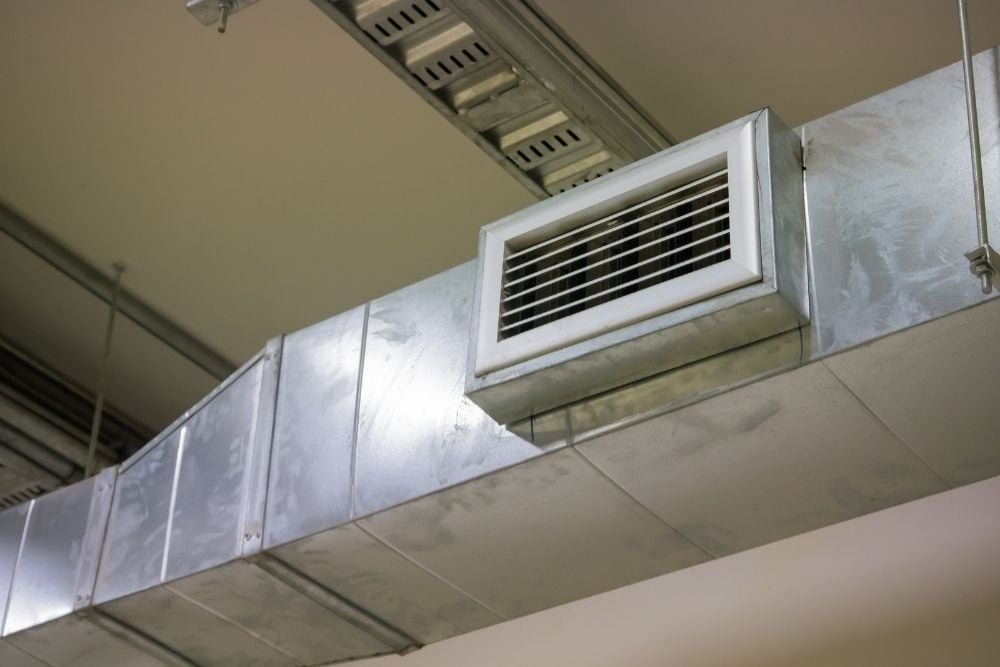
Rectangular ductwork is fabricated from folded sheet metal sections joined into a box profile. It has been widely used on commercial ventilation projects for decades.
Flat oval ductwork sits somewhere between the two. It starts life as spiral ductwork before being pressed into a flatter oval shape, allowing it to fit into tighter ceiling voids.
Each type solves a different problem. The right choice depends on the building layout and the demands of the system.
Spiral Ductwork
Spiral ductwork has become the standard option on many modern ventilation projects, and for good reason.
The spiral lock seam gives the duct rigidity without requiring the heavier steel gauges often needed on rectangular systems.
It also performs well from an airtightness point of view. Circular sections naturally seal more effectively at joints, helping properly installed systems meet the higher leakage classes specified in BESA DW/144.
Noise performance is another advantage. Circular ductwork resists drumming and panel flexing better than rectangular sections, which helps reduce duct borne noise through the system. On more demanding installations, supporting attenuators can be added to deal with residual fan or duct borne sound.
Airflow efficiency is strong too. Circular ductwork has less surface area for the same cross sectional area, reducing friction loss and lowering the resistance the fan has to overcome.
Installation is usually quicker as well. Standard bends, reducers, and tees are straightforward to assemble on site using slip couplers or quick fit systems.
Spiral ductwork works particularly well on:
- MVHR systems
- Commercial supply and extract systems
- Exposed industrial style installations
- Projects where airtightness, efficiency, or noise control matter
Where spiral can become difficult is in shallow ceiling voids where the diameter simply will not fit, or on very large air volume systems where duct sizes become impractical.
Rectangular Ductwork
Rectangular ductwork still makes sense in plenty of applications, especially where space constraints drive the design.
Its biggest strength is how efficiently it uses ceiling void and riser space. The section can be sized precisely to suit the available depth, which is often critical on commercial projects where ceiling space is heavily restricted.
It also handles large air volumes effectively. On high capacity systems, rectangular ductwork can remain manageable where equivalent circular duct sizes would become excessively large.
There is also the practical side. Most contractors are familiar with it, detailing standards are well established, and fittings are widely available.
That said, there are trade offs.
Rectangular ductwork has more surface area than circular ducting for the same airflow capacity, which increases friction loss.
Joint leakage is typically higher too, meaning sealing and testing become more important if the project has strict airtightness requirements.
Noise can also become an issue if sections are not properly stiffened, particularly on higher pressure systems where panel vibration causes drumming.
Rectangular ductwork is usually the right choice for:
- Large commercial ventilation systems
- Projects with restricted ceiling depth
- Plant rooms and riser sections
- Extensions or retrofit work connecting into existing rectangular systems
What it should not be is the automatic default on every commercial project.
Flat Oval Ductwork
Flat oval ductwork sits in the middle ground between spiral and rectangular.
It keeps many of the performance advantages of spiral ductwork while reducing the height of the duct profile enough to work in tighter ceiling voids.
The construction is effectively the same as spiral ductwork. The steel gauge and spiral seam remain unchanged. Only the shape differs.
Because of that, flat oval generally performs much closer to spiral than rectangular in terms of airtightness and airflow efficiency.
There is a small increase in friction loss due to the flatter profile, but it is still considerably more efficient than rectangular ductwork in most situations.
Flat oval earns its place on:
- Tight ceiling void projects
- Retrofit installations with awkward constraints
- Architecturally sensitive exposed systems
- Projects where spiral duct fittings can still be used with flat oval transitions
The main limitation tends to be fittings availability. Compared with spiral, the fittings range is narrower and lead times can sometimes be longer on less common sizes.
Choosing the Right Ductwork Type
In most projects, the decision comes down to four things.
The first is airflow volume. Larger air volumes often push systems toward rectangular ductwork for practical size reasons, while smaller and medium sized systems are usually well suited to spiral or flat oval.
The second is available space. Tight ceiling voids can quickly rule out full circular sections.
The third is performance. Where airtightness, energy efficiency, or noise reduction matter, spiral ductwork is usually the strongest option, with flat oval close behind. Design-side guidance on these trade-offs is covered in detail in CIBSE Guide B2: Ventilation and Ductwork, which sits alongside BESA DW/144 as a standard reference on this side of the industry.
The fourth is visibility. Exposed spiral ductwork has become a deliberate design feature on many modern commercial fit outs. Rectangular ductwork rarely gets chosen for exposed architectural installations.
In reality, many systems combine all three types. Spiral on the main distribution runs. Rectangular through plant areas. Flat oval through restricted ceiling zones.
The important thing is making the choice deliberately rather than relying on habit.
Common Mistakes We See
After more than 35 years supplying contractors across the UK and Ireland, certain problems appear again and again.
Rectangular ductwork gets specified on projects where spiral would install faster and perform better simply because the original drawings showed rectangular.
Spiral ductwork gets forced into ceiling voids that are too shallow, leading to crushed sections and restricted airflow.
Flat oval fittings are left too late in the procurement process, creating avoidable delays on site.
Different ductwork systems get mixed together without properly designed transitions, creating turbulence and unnecessary pressure loss.
Most of these problems are easy to avoid if the ductwork decision gets proper attention early in the design stage.
Speak to the Team Before You Order
If you are planning a ventilation project and need practical advice on the right ductwork system, speak to the team at Fresh Air Supplies.
We manufacture galvanised spiral ductwork in house, maintain high stock levels of fittings, and supply rectangular and flat oval ductwork across the UK and Ireland.
With more than 35 years of experience supporting both contractors and ventilation projects, we can help you choose a ductwork solution that suits the building, the installation, and the budget properly from the start.
Update On 20 Oct 2026
In this article, we explored how crucial it is to move away from habit and carefully select the right ventilation systems for modern commercial projects. We looked into the distinct advantages of spiral, rectangular, and flat oval ductwork, focusing on how factors like airflow, noise control, airtightness under BESA DW/144, and space constraints influence performance. Specifically, incorporating flat oval ductwork and spiral ductwork can significantly optimise efficiency in tight ceiling voids and MVHR setups. We recommend evaluating your building layout and consulting industry standards like CIBSE Guide B2 early in the design stage to avoid costly installation errors and turbulence.