

Modern buildings are becoming more airtight as energy efficiency standards improve. While this helps reduce heat loss, it also means that fresh air cannot enter the building naturally as easily as it once did.
This is where heat recovery ventilation units play an important role.
A heat recovery ventilation system allows fresh air to enter a building while recovering energy from the stale air being extracted. This improves indoor air quality while reducing the overall energy required to heat or cool the space.
Why Fresh Air Ventilation Is Important
Without proper ventilation, indoor spaces can quickly build up stale air, humidity and pollutants. In commercial environments this can lead to:
-
Poor indoor air quality
-
Condensation and humidity problems
-
Uncomfortable working environments
-
Reduced system efficiency
Mechanical ventilation systems solve this by continuously supplying fresh air and removing stale air.
However, simply extracting warm indoor air and replacing it with cold outside air can waste large amounts of energy. This is why heat recovery ventilation systems are commonly used in modern commercial HVAC systems.
How Heat Recovery Ventilation Works
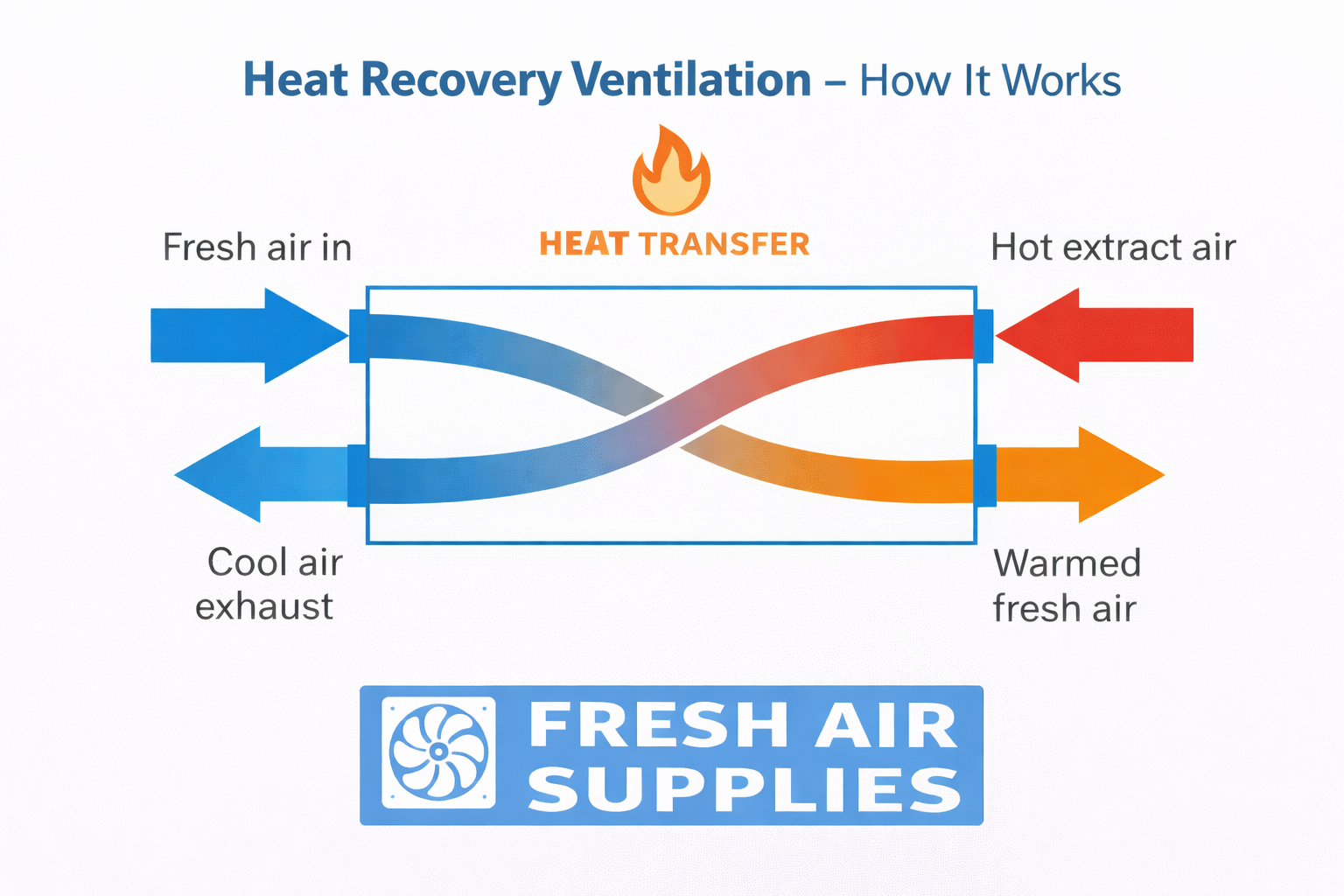
A heat recovery unit works by transferring heat energy from outgoing stale air to the incoming fresh air supply.
Inside the unit, two separate air streams pass through a heat recovery core. The air streams never mix, but heat energy is transferred between them.
The process works like this:
-
Stale air is extracted from the building via common extraction ports such as extract valves or the recently more popular Ergovent Rondo invisible air valves.
-
Fresh outdoor air is drawn into the ventilation unit via rigid or flexible duct linked to the extraction ports.
-
The heat recovery core transfers heat from the outgoing air to the incoming air.
-
Pre-warmed (or pre-cooled) fresh air is then supplied to the building via common supply ports such as Supply Valves or the recently added Ergovent Kvadro invisible air valve. Another popular supply choice for commercial settings is a simple 4 way diffuser which is paired with a back plenum box to for easy installation to the duct system.
This process allows buildings to maintain ventilation without losing valuable heating or cooling energy.
What Is an Enthalpy Heat Recovery Core?
Many modern systems, including the Mitsubishi Heavy Industries SAF range, use an enthalpy heat recovery core.
This type of core transfers both:
-
Heat energy
-
Moisture
This helps maintain comfortable humidity levels within the building while improving overall ventilation efficiency.
The SAF units use a corrugated cross-layered paper core, allowing efficient heat and moisture exchange between the incoming and outgoing air streams.
Where Heat Recovery Ventilation Units Are Used
Heat recovery ventilation systems are commonly installed in commercial and light industrial buildings where good indoor air quality and energy efficiency are both important.
Typical applications include:
-
Office buildings
-
Retail and hospitality environments
-
Schools and education facilities
-
Commercial developments
-
Light industrial premises
In these environments, heat recovery ventilation helps maintain consistent airflow while reducing the load on heating and cooling systems.
Benefits of Heat Recovery Ventilation Systems
Heat recovery ventilation units offer several advantages compared with traditional extract-only systems.
Improved Indoor Air Quality
Fresh air is continuously supplied while stale air is removed.
Energy Efficiency
Heat energy from extracted air is recovered and reused.
Reduced Heating and Cooling Demand
Incoming air is pre-conditioned before entering the building.
Lower Operating Costs
Reduced HVAC load helps improve overall energy performance.
Comfortable Indoor Environments
Balanced ventilation helps maintain consistent temperatures and humidity levels.
Mitsubishi SAF Heat Recovery Ventilation Units
The Mitsubishi Heavy Industries SAF heat recovery ventilation units are designed for commercial HVAC systems where reliable fresh air ventilation and energy efficiency are required.
These units provide:
-
High efficiency enthalpy heat recovery
-
Continuous fresh air supply
-
Cooling mode when outdoor air is cooler than indoor air
-
Quiet operation suitable for commercial environments
-
Compact design for easier installation
The SAF range is available in multiple sizes to suit different ventilation requirements.
Selecting the Right Heat Recovery Unit
Choosing the correct heat recovery ventilation unit depends on several factors, including:
-
Required airflow rate
-
Size of the building
-
Duct system resistance
-
Heating and cooling requirements
A properly sized system will ensure efficient operation while maintaining good indoor air quality.
If you are unsure which heat recovery unit is suitable for your project, the Fresh Air Supplies team can assist with selection and system advice.
Need Help Choosing a Heat Recovery Ventilation Unit?
If you would like more information about the Mitsubishi SAF heat recovery ventilation units, or need assistance selecting the correct model for your ventilation system, please get in touch.
☎️ Call: +44 (0) 28 8675 2336
📧 Email: sales@freshairsupplies.co.uk